

How confident are you that your engineering information still matches the asset?
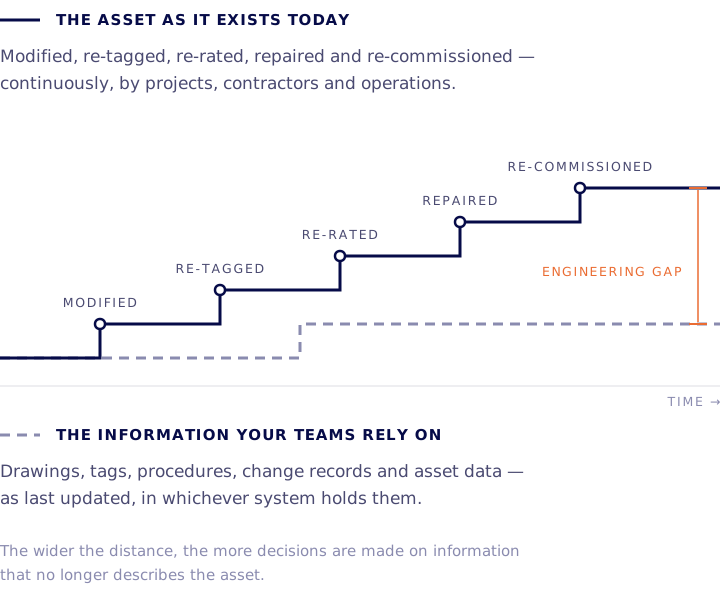
Projects hand over, assets are modified, and systems are updated independently of each other. Over time, what your teams work from stops describing what is actually there. That distance is the Engineering Gap.
- 9 questions
- 2 minutes
- Immediate result
- No preparation needed
Built for engineering and asset teams in complex industrial operations
Engineering Managers · Asset Integrity leaders · Engineering & Asset Information Managers · Document and Information Control leaders · Operations and technical leadership
See how an Engineering Gap opens
An engineering change has been approved on a live unit. Trigger it, and watch how far it actually travels across the engineering information your teams depend on.
Two areas align. Two do not. On paper the change is closed. In practice, part of your engineering information now describes an asset that no longer exists — and nobody owns the difference.
When should you assess your Engineering Gap?
Four situations where the distance between the approved state and the actual state stops being theoretical. If one of them describes where you are, the assessment is worth two minutes.
01 / Engineering change / MOC
Managing frequent engineering changes?
Can you verify that an approved change reached every affected document, tag and system — rather than assuming it did?
02 / Handover
Approaching handover ?
Is the engineering information genuinely ready for operations, or only marked complete?
03 / Audit & compliance
Preparing for an audit or regulatory review?
Can you demonstrate the current approved state without weeks of manual reconciliation?
04 / AI & digital twin
Starting an AI or digital twin initiative?
AI can find engineering information quickly. It cannot make outdated information correct. Can you trust what sits underneath?
Engineering information that keeps pace with the asset
The goal is not to store more information. It is to keep the engineering information that matters accurate, traceable and current as the asset is built, handed over, operated and changed — so that the people making decisions are working from what is actually there.
- Approved changes can be verified, not assumed
- Engineering information stays aligned with the asset as it changes
- Handover is ready for operations, not only administratively complete
- The current approved state can be demonstrated on request
- Digital and AI initiatives run on engineering information that is governed
In two minutes, see where your engineering information is most exposed
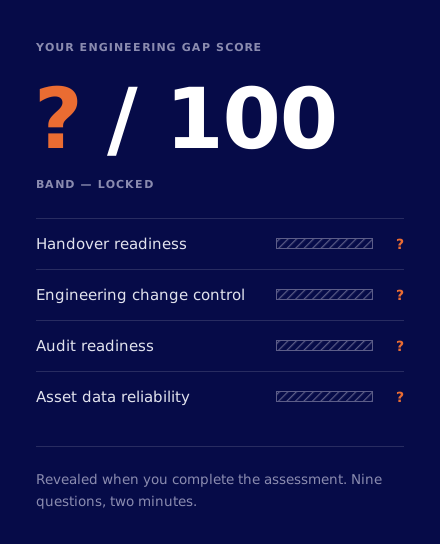
Nine questions across the four dimensions the assessment scores. You get a clear view of where confidence breaks down, which areas need attention first, and what is practical to address — not just a number.
- Your Engineering Gap Score — one figure you can take into a meeting
- A view across all four dimensions — handover readiness, engineering change control, audit readiness and asset data reliability
- Where you are strongest and weakest — and which areas need attention first
- Practical next steps — what to do about the weakest dimension
Nine questions. Two minutes. Your results are shown immediately and sent to you by email.
Where this assessment comes from
Assai builds and runs engineering information management for asset-intensive operators. The assessment scores the four dimensions where engineering information most often falls out of step with the asset.
A focused diagnostic across four dimensions
Nine questions across four dimensions: handover readiness, engineering change control, audit readiness and asset data reliability. You are scored on how your organisation works today, not on what it intends to do.
Written from work on live assets
The assessment reflects the engineering information challenges Assai works with across projects, handover and operations. Our published customer cases show how issues around handover, change control and information reliability play out on real assets and projects.
Common Questions
How long does the assessment take?
Nine multiple-choice questions, about two minutes. There is nothing to prepare and nothing to look up. Your results appear as soon as you finish and are sent to you by email.
What will I receive?
Your Engineering Gap Score, a view across all four dimensions — handover readiness, engineering change control, audit readiness and asset data reliability — your strongest and weakest areas, and the areas that need attention first, with practical next steps for the weakest one.
How is the score calculated?
Each of the nine questions maps to one of the four dimensions and asks how your organisation works today rather than what it aspires to. Your answers produce a score for each dimension, and those combine into a single Engineering Gap Score out of 100.
What information do you need from me?
Your answers to the nine questions, and your name, work email and organisation so the report can be sent to you. No system access, no documents and no commercial information.
What happens to my data?
Your responses are used solely to calculate your Engineering Gap Score and generate your report. They are not shared with third parties and are handled in accordance with our privacy policy.
Want a figure to take into the conversation?
The Engineering Gap Assessment tells you where your engineering information is exposed. If you also need a rough order of magnitude for a capital programme, the rework cost calculator gives you an indicative number from three inputs.
It is a sizing tool, not a diagnosis. Use the assessment first to understand where your engineering information is exposed, then use the calculator to explore the potential financial scale.
Start with the assessment: Take the 2-minute assessment →
Find out how wide your
Engineering Gap is
Nine questions. Two minutes. Your score, your weakest areas and what to prioritise — immediately.
Already have your score? Book a 30-minute conversation with a specialist and bring your score and a real scenario from your operation.